



















- Rising operational costs and staffing shortages are the top challenges facing ASCs, and both are driving demand for technology that helps centers do more with the staff they have.
- Improving revenue cycle management is the top strategic priority among ASCA 2026 attendees, and interest in outsourcing RCM functions is growing as staffing challenges make in-house operations harder to sustain.
- AI adoption in ASCs is accelerating, and operative note transcription is emerging as one of the most practical entry points for centers looking to get started.
- ASCs are actively evaluating analytics, compliance, and management software, reflecting broad momentum to modernize and consolidate their technology infrastructure.
- ASC leaders are taking cybersecurity seriously, and the turnout for SIS's session on cyber resilience at the ASCA meeting reflected that growing awareness.
The ASCA + SAMBA 2026 Annual Conference brought the ambulatory surgery community together May 13–16 in Washington, D.C. Celebrating its 30th year as a trusted partner to more than 2,900 ASCs, Surgical Information Systems (SIS) attended as a silver sponsor. Hundreds of ASC leaders — current clients and prospective partners — stopped by the SIS booth during the conference, and the team conducted its annual on-site survey to hear directly from the community.
"ASCA always draws people who are serious about running their centers well," says Daren Smith, RN, BSN, Vice President of ASC Solutions at SIS. "The conversations we had this year — with clients and many people we hadn't met before — reflected real urgency. The pressures on ASCs right now are significant, but you don't get a sense of paralysis at a meeting like this. People are actively working through these challenges by looking for the solutions, services, and experts who can help them."
More than 50 ASC leaders responded to the SIS annual survey, including administrators, clinical leaders, and executives representing independent ASCs, management groups, health system–affiliated centers, and multi-site networks.
What's Weighing on ASCs
When asked to identify their ASC's top challenges for 2026, respondents named the following most frequently:
-
Rising operational costs: 60%
-
Staffing shortages, retention, and turnover: 58%
-
Prior authorization and payer delays: 25%
-
Patient payment collections: 23%
-
Compliance and accreditation readiness: 23%
"What you hear at ASCA confirms what the data shows," says Smith. "Costs are up, and the people managing everything are harder to find and harder to keep. The centers that are managing well are investing in technology that gets staff out of repetitive tasks and into higher-value work. That's a practical response to today's economic reality."
What ASCs Are Working Toward
When asked about their top priorities for the year, respondents named:
-
Improve revenue cycle management: 55%
-
Enhance reporting and data analytics: 40%
-
Strengthen compliance: 36%
-
Automate clinical and business workflows: 28%
-
Improve the patient experience: 28%
"Revenue cycle performance comes up in almost every conversation we have with ASC leaders, and the reasons vary," says Jessica Nelson, Senior Vice President of RCM Operations at SIS. "Some centers are leaving money on the table because of coding gaps or denials they don't have the bandwidth to work. Others are watching days in A/R creep up and aren't sure where the breakdown is. What they have in common is that they know their revenue cycle could be performing better, and they're looking for a path to get there."
Revenue Cycle: In-House Is Still the Norm, But That's Shifting
While most survey respondents indicated that they still manage their revenue cycle in-house, a significant portion either fully outsource their billing, operate on a hybrid model, or are actively evaluating outsourcing as an option. Revenue cycle management services ranked among the top solutions respondents identified as an area of interest.
SIS Revenue Cycle Services supports ASCs across the full spectrum of need — from full-scale RCM management to individual services including billing, coding, and transcription.
"The conversations we had at ASCA reflected something we've been hearing more over the past year: administrators asking harder questions about whether handling all of their billing and coding internally still makes sense for their center," says Nelson. "Staffing is a big part of that. When you can't find or keep experienced coders and billers, or if you're adding a new specialty that requires expertise that can be difficult to find, the calculus changes. We also had meaningful conversations with clients who have chosen SIS as their RCM outsourcing partner and are happy with the decision, and hearing that directly from peers matters to administrators who are still weighing their options."
AI: Moving From Curiosity to Practice
Among survey respondents, 15% are actively piloting AI solutions and 8% are already using AI in their operations. Another 13% plan to begin evaluating AI within the next 12 months. The largest single group — 34% — described themselves as interested but unsure where to start. Among those already piloting or using AI, analytics and reporting is the most common application, followed by revenue cycle, documentation and coding, patient communication, and scheduling.
Operative note transcription is one of the more concrete opportunities. Completing an op note after a case is finished is a persistent challenge in most ASCs — surgeons move quickly from one case to the next, and notes that don't get done promptly create delays for billing teams and coders. For centers doing complex cases involving implants or specialized hardware, documentation gaps carry additional revenue risk.
"Transcription is a good place for a lot of centers to start with AI because the problem it solves is tangible and the path to getting started is straightforward," says Smith. "Physicians need to complete operative notes faster and more accurately. AI can do that today, and it fits into a workflow they already have. For centers that have been cautious about AI, this is a practical first step with a clear return."
SIS Scribe, introduced at ASCA 2026, is built for that problem. Trained to understand how physicians speak — including complex medical terminology and clinical context — it produces more complete, accurate operative notes and gets them to billing teams faster. Learn more at sisfirst.com/sis-scribe.
Modernizing the Technology Stack
Beyond RCM and AI, respondents identified the following as solutions they are interested in evaluating:
-
Analytics and reporting: 38%
-
ASC management software: 36%
-
Compliance and logs management: 34%
-
Revenue cycle management services: 28%
-
Electronic medical records: 23%
"What we're seeing with a lot of organizations is that the technology foundation work is still in progress — moving to the cloud, integrating systems, standardizing across locations," says Lindsay Hanrahan, Vice President of Product Management at SIS. "That's significant work, and it doesn't happen quickly. But the centers that have completed that transition are now focused on getting more out of what they have: acting on data, automating more of the routine work, connecting workflows that used to run separately. As those returns become visible, it tends to generate more questions about what's possible."
The interest in compliance technology aligns with SIS's recent addition of SIS Comply to its portfolio. Built for the outpatient surgery industry, SIS Comply consolidates accreditation, compliance, and credentialing management on a single cloud platform.
"Compliance management has traditionally been handled through a combination of spreadsheets and manual processes," says Hanrahan. "SIS Comply gives ASCs a purpose-built alternative, and we've seen strong interest from centers that are looking to manage that critical work in a single system."
SIS also used the meeting to introduce several expanded capabilities for SIS Complete, the cloud-based ASC management platform used by more than 90,000 physicians who have documented over 11 million cases. New additions include:
-
Long-Term Patient Outcomes, which automates the distribution of post-operative questionnaires, making it easier for ASCs to track patient outcomes for ASC-21 compliance, accreditation, and their own internal quality metrics.
-
SIS Office Anesthesia, which simplifies the setup and calculation of anesthesia-specific billing charges, giving ASCs a straightforward way to bill for anesthesia provider services.
-
SIS Complete Enterprise Edition, which brings enhanced capabilities for multi-center organizations, allowing them to unify operations across locations on a single connected platform.
Taking Cybersecurity Seriously
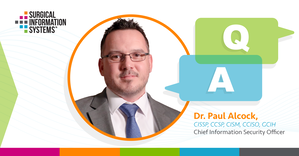
Paul Alcock, DIT, CISSP, CCSP, CCISO, CISM, GCIH, Chief Information Security Officer at SIS, presented a session at the annual meeting titled "Unlocking ASC Cyber Resilience," walking attendees through a realistic ransomware attack scenario and the practical steps ASCs can take to prepare.
"I was glad to see a solid turnout for a cybersecurity session," says Alcock. "It's a topic that can feel removed from day-to-day operations until something goes wrong, so the goal was to make the risk concrete — to show what an actual incident looks like inside an ASC and what preparation actually requires. The questions from the audience were substantive. People are thinking about this and taking the risk seriously, and that's the right starting point."
A Community Moving Forward
The ASCA + SAMBA 2026 Annual Conference gave SIS the opportunity to hear directly from hundreds of ASC leaders across the country, and the conversations reinforced what the survey data showed.
"What stood out this year was how consistent the themes were — whether we were talking to a single-specialty independent center or a large multi-site group, the conversations kept coming back to the same things: costs, staffing, technology, and how to keep the revenue cycle performing," says Jake Behnke, Vice President of Marketing at SIS. "That kind of alignment across the community is genuinely useful, because it tells us where to focus. We're grateful to ASCA for bringing everyone together, and we're looking forward to putting what we heard to work."
To learn more about how SIS can help your ASC Operate Smart™, visit sisfirst.com.